Saturday, September 29, 2012

Celebrating Spring with Hugs


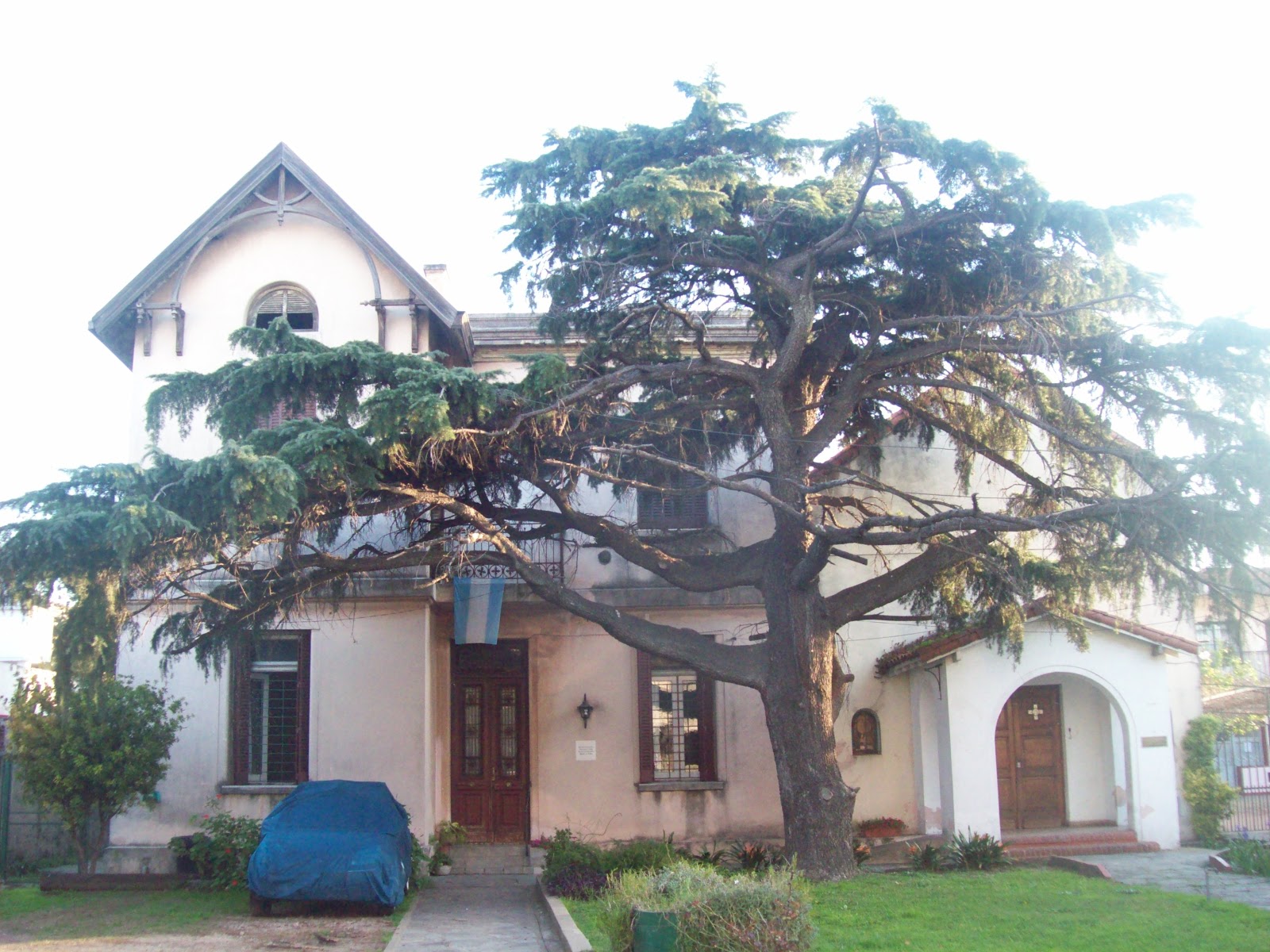
 Beautiful "glisinias" (wisterias) in the church patio, heralding the arrival of spring!


Last Friday, September 21st, was the first day of spring here in Argentina, and I had the unique opportunity to celebrate spring’s arrival with the elementary school in Jose León Suárez, the neighborhood that many of the members of the Santo Sacramento congregation come from.  Alejandra, a friend from the church who works at the school, invited me to share lunch with the staff and then partake in the springtime festivities afterward.  In the principal’s office, I helped prepare little bags of candy while listening to a mix of spring-themed songs.  The bags of candy served as prizes for the games that then took place outside.  In the midst of the somewhat chaotic blur of music, yelling children, candy, and air-borne balls, I got a few curious questions from the kids about who I was and even a few hugs.  I was baffled by their capacity for affection toward me after only having known me for a few moments.  One of the students I recognized from Santo Sacramento, and she too gave me a hug and asked me if I was going to church on Sunday, and she said she’d see me there. 

Later, while reading “Gracias: A Latin American Journal,” a book by the Dutch priest Henri Nouwen, I was reminded of the children’s affection.  Nouwen visited several orphanages in Bolivia in the 1980s, and after visiting one of them, he recorded the following thoughts:

“How little do we really know the power of physical touch.  These boys and girls only wanted one thing: to be touched, hugged, stroked, and caressed.  Probably most adults have the same needs but no longer have the innocence and un-self-consciousness to express them.  Sometimes I see humanity as a sea of people starving for affection, tenderness, care, love, acceptance, forgiveness and gentleness.  Everyone seems to cry “Please love me.”  The cry becomes louder and the response so inaudible that people kill each other and themselves in despair.  The little orphans tell more than they know.  If we don’t love one another, we kill one another.  There’s no middle road”  (Nouwen, 1983, p. 44). 

Wow.  That passage is so powerful and personal for me.  Everyone wants to be loved, and everyone wants to be hugged, including me.  I too crave physical touch, perhaps even more so now that I am on my own in a foreign country.  And I have observed how powerful physical touch can be in my interactions with the children at Santo Sacramento and the individuals at El Arca.  Many of the people I interact with here hunger for affection more than I do because they have experienced neglect or rejection in some way.  By demonstrating my love for them, I hope to quench to some degree their thirst, and in return I have received much love as well.  It has been especially important for me to receive this gift being so far away from my home, family, friends and everything familiar.  And as my dear friend Becki has reminded me, when we love each other, give to each other etc., we also love and give to God.    

El Arca as an organization seems to agree with Nouwen about the power of physical touch.  Of course, it’s no surprise that Nouwen and El Arca should align philosophically considering that Nouwen spent the last ten years of his life (1986-1996) living in an El Arca community in Toronto, Canada.

On Wednesday, the El Arca workshop walked around the neighborhood to offer free hugs, bearing a poster with the El Arca logo.  We stopped passers by to ask them if they would like a free hug and then handed them a candy and a souvenir from the workshop.  A few people were reluctant to play along, but most gladly accepted their free hugs.  One woman even said, “thank you, I need a hug!”

There is also a dark side to Nouwen’s reflection about humanity’s need for love.  The penultimate sentence “If we don’t love one another, we kill one another” suggests that all violence has roots in the absence of love.  Have the most violent crimes been desperate cries from those who seek acceptance, belonging, and love?  In this complex world, nothing can be over-simplified, but I think Nouwen is on the right track, especially in light of what I have learned about the lives of juvenile “delinquents” in Argentine “villas.”  With no educational or professional opportunities available to them, young people in the poorest neighborhoods resort to selling drugs and stealing in order to survive.  These young people, in addition to experiencing poverty, often also experience some form of neglect or violence in their families of origin, and on top of that, they are discriminated against by the larger society. 

Many of them end up in prison, like the youth in “Instituto Almafuerte,” which I recently learned about by watching a documentary at a local museum.  http://www.escribiendocine.com/peliculas/el-almafuerte  The documentary tells the story of a film workshop for the young men in this maximum-security detention center.  During the discussion after the documentary, one of the women in the audience commented that the benefits of the workshop demonstrated that when people feel respected, appreciated, and loved, the best of their humanity comes out.  Oppression, neglect, and rejection, on the other hand, bring out the worst in people.  It’s simple. 

I think the whole world should get together for a group hug.  It would be a small step toward achieving world peace.  :-)

And now (Monty Python style) for something completely different!

Noelia and Maxi with their super-cool sunglasses in the El Arca workshop:


Cookies with a Lisa twist- based on a Betty Crocker chocolate chip cookie recipe but with pieces of apple instead of chocolate chips, with whole wheat flour and with a banana added.  Yum!



Tuesday, September 18, 2012

Connecting through Song


Yesterday was a special day at “El Arca” because I was able to accompany a friend from Santo Sacramento, Claudio, there!  We had been trying to arrange this for several days, but unfortunately, Claudio wasn’t feeling well last week.  I was so relieved and happy to finally be able to bring him there.  Everyone at El Arca gave him a warm welcome, complete with a welcome song at lunch (I learn something new about El Arca traditions everyday!), and I am glad to report that Claudio had a great first day!


It turns out that Claudio is a Boca fan, so now Osvaldo has an ally on the “cancha” (soccer field).  Claudio is not, however, a fan of the singer Axel, but Noelia is trying to convert him nevertheless.  Today, while cleaning up after lunch in the kitchen, Noelia and I broke into song with Axel’s “Celebra La Vida” (Celebrate Life), and Claudio booed us!  Noelia and Claudio will have to agree to disagree I guess.  Meanwhile, Noelia will continue to teach me Axel repertoire.

Claudio prefers cumbia and reggaeton.  Luckily, I know some reggaeton songs myself, primarily thanks to all those zumba classes I attended last year.  On the walk back to the taller, he and I sang “danza kuduro,” “pobre diabla” and “ven bailalo.”

Speaking of songs, before eating our weekly pizza on Sundays at Santo Sacramento, we have a quirky prayer ritual.  We hum “The Adams Family” theme song, and then we sing “Bendice señor la mesa, bendice los alimentos, bendice a todos y a todas, Amen” (Bless o lord the table, bless the foods, bless all of us, Amen).  Then, we all hold hands, and chant, while shaking our clasped hands up and down “BUEN PROVECHO!” (bon apetit- do we even have a version of this in English??).  Actually, I think the buen provecho part is  fairly common.  I really like it- it’s a beautiful way to start a meal with friends. 

I have always loved to sing, but I never imagined that singing with my new friends in Argentina would play such an important, yet informal role in making personal connections.

Earlier on this blog I mentioned the possibility of starting a choir at Santo Sacramento.  To be honest, I doubt that this will happen because of how young the children I work with are (3-5 years old) and because of the informal nature of the Sunday activities.  We don’t need to form a choir to sing though.  This Sunday I tried to teach them a hymn while they were coloring- I sang a phrase and then had them repeat it and so on.  They didn’t quite catch on, but I was delighted that they actually took interest in learning it.  I hope to learn a song or two from them as well.

Today is unfortunately quite rainy, but on the plus side, it gave me an excuse to sing “I’m singing in the rain . . .”  It’s too bad that movie isn’t well known here in Argentina.  Well, you can’t have everything!

Lisa

Saturday, September 15, 2012

My El Arca "Family"


As anyone who has worked, volunteered, or lived in an El Arca/L’Arche community will tell you, friendship is central to the L’Arche philosophy and lifestyle.  Consequently, most of the “work” I have done so far is intangible.  Of course there are concrete tasks along the way- assembling “sopapas” (drain stoppers), washing dishes, folding laundry, making visits to the medical center or psychologist etc., but they are secondary to the relationships I am forming. 

At first this was hard for me to accept.  I felt that I wasn’t being productive enough, true to my North American cultural heritage.  Yet I’m becoming accustomed to the relaxed pace of the workshop and home, and the people there have become my adoptive Argentinian family.      

I have written bios for some of my friends at El Arca so you can get to know them too:

Osvaldo:

Osvaldo is a charming man of 64 years.  He is a loyal fan of “Boca,” one of the Buenos Aires futbol teams.  He has a boca flag in his room, a boca backpack that he takes everywhere, and a boca mug.  On Wednesday afternoons when Juan leads the painting workshop, Osvaldo always wants to use the boca colors: yellow and blue.  Osvaldo endures much harassment from the “River” fans, who greatly outnumber him. 

Osvaldo is also a great, affectionate friend.  During my first week at El Arca, he showed me his photo album, which is full of pictures of his friends.  One of his favorites is Padre (father) Pepe, the priest who suggested that Osvaldo live in the home to begin with.  Osvaldo talks about Padre Pepe and his godparents often. 

Osvaldo and I share a passion for desserts.  He becomes very animated when a dessert appears.  I would say that I become just as animated but I hide my excitement. 

Maxi:

Maxi is a 20-year-old bundle of energy.  He likes to sing, play basketball, and swim.  Maxi has been teaching me to sing songs by the Argentinian rock band "Mambru," and on Thursday, we played a game of basketball at the park with some local kids. 

Julio:

Julio and I always sit next to each other at lunch, because we are creatures of habit, and because, as he says “nos cameos bien” (we like each other/get along with each other).  Julio is one of the most polite people I’ve ever met.  He always asks me how I’m doing and whether I’ve talked with my parents and how they’re doing.  Sometimes it’s difficult for me to understand what he is saying, but he says I’m getting better.  He’s very patient with me. 

Sandra:

Sandra is 21 and full of life.  She a great “matera” (drinker of mate) and loves to listen to music.  She also has a taste for large, rose colored sunglasses.  I don’t see her as often as the others because she goes to school during the day.  It didn’t take long for her to warm up to me, though.  She says we are great friends already. 

Marcos:

Marcos (Marquitos, affectionately) is a sweet boy of 14.  He is blind but has, in my opinion, a remarkable awareness of who surrounds him.  A mere hour or so after first meeting me, he could tell who I was by my voice, or by feeling my face or arm.  Marcos also goes to school, so I don’t see him a lot.  He and I have listened to his reggaeton CD together a few times though. 

Dani:

Dani is a fan of “River” but a great friend of Osvaldo’s nonetheless.  In addition to attending the workshop, he has an internship with a local carpenter.  Dani is very talkative and has given me many tips about staying safe in Argentina.  In addition to carpentry, he enjoys playing the guitar and fishing.

Noelia:

Noelia is the biggest fan ever of the Argentinian popstar Axel, who is now one of the judges on “La Voz Argentina” (the Argentinian version of “The Voice.”)  Noelia talks about Axel often and likes to sing his songs (with a lovely voice I must say) and watch “La Voz.”  Noelia is also the proud aunt of a tiny baby girl who she looks after from time to time.

Yanet:

Yanet is a talented artist.  I have seen her draw castles, dogs, ballerinas, and unicorns.  She is soft-spoken and kind and comes a few days each week with her brother Diego.  We celebrated Diego’s birthday on the 11th.  He treated us to his special homemade pizza. 


So there you have it, a snap shot of the people I’ve been spending my time with these days.  I am in good hands!  


My El Arca "Family"

As anyone who has worked, volunteered, or lived in an El Arca/L’Arche community will tell you, friendship is central to the L’Arche philosophy and lifestyle.  Consequently, most of the “work” I have done so far is intangible.  Of course there are concrete tasks along the way- assembling “sopapas” (drain stoppers), washing dishes, folding laundry, making visits to the medical center or psychologist etc., but they are secondary to the relationships I am forming. 

At first this was hard for me to accept.  I felt that I wasn’t being productive enough, true to my North American cultural heritage.  Yet I’m becoming accustomed to the relaxed pace of the workshop and home, and the people there have become my adoptive Argentinian family.      

I have written bios for some of my friends at El Arca so you can get to know them too:

Osvaldo:

Osvaldo is a charming man of 64 years.  He is a loyal fan of “Boca,” one of the Buenos Aires futbol teams.  He has a boca flag in his room, a boca backpack that he takes everywhere, and a boca mug.  On Wednesday afternoons when Juan leads the painting workshop, Osvaldo always wants to use the boca colors: yellow and blue.  Osvaldo endures much harassment from the “River” fans, who greatly outnumber him. 

Osvaldo is also a great, affectionate friend.  During my first week at El Arca, he showed me his photo album, which is full of pictures of his friends.  One of his favorites is Padre (father) Pepe, the priest who suggested that Osvaldo live in the home to begin with.  Osvaldo talks about Padre Pepe and his godparents often. 

Osvaldo and I share a passion for desserts.  He becomes very animated when a dessert appears.  I would say that I become just as animated but I hide my excitement. 

Maxi:

Maxi is a 20-year-old bundle of energy.  He likes to sing, play basketball, and swim.  Several afternoons Maxi and I have sung along to a CD of Mambru, an Argentinian rock band.  This afternoon, we joined some local boys for a game of basketball. 

Julio:

Julio and I always sit next to each other at lunch, because we are creatures of habit, and because, as he says “nos cameos bien” (we like each other/get along with each other).  Julio is one of the most polite people I’ve ever met.  He always asks me how I’m doing and whether I’ve talked with my parents and how they’re doing.  Sometimes it’s difficult for me to understand what he is saying, but he says I’m getting better.  He’s very patient with me. 

Sandra:

Sandra is 21 and full of life.  She a great “matera” (drinker of mate) and loves to listen to music.  She also has a taste for large, rose colored sunglasses.  I don’t see her as often as the others because she goes to school during the day.  It didn’t take long for her to warm up to me, though.  She says we are great friends already. 

Marcos:

Marcos (Marquitos, affectionately) is a sweet boy of 14.  He is blind but has, in my opinion, a remarkable awareness of who surrounds him.  A mere hour or so after first meeting me, he could tell who I was by my voice, or by feeling my face or arm.  Marcos also goes to school, so I don’t see him a lot.  He and I have listened to his reggaeton CD together a few times though. 

Dani:

Dani is a fan of “River” but a great friend of Osvaldo’s nonetheless.  In addition to attending the workshop, he has an internship with a local carpenter.  Dani is very talkative and has given me many tips about staying safe in Argentina.  In addition to carpentry, he enjoys playing the guitar and fishing.

Noelia:

Noelia is the biggest fan ever of the Argentinian popstar Axel, who is now one of the judges on “La Voz Argentina” (the Argentinian version of “The Voice.”)  Noelia talks about Axel often and likes to sing his songs and watch “La Voz.”  Noelia is also the proud aunt of a tiny baby girl who she looks after from time to time.

Yanet:

Yanet is a talented artist.  I have seen her draw castles, dogs, ballerinas, and unicorns.  She is soft-spoken and kind and comes a few days each week with her brother Diego.  We celebrated Diego’s birthday on the 11th.  He treated us to his special homemade pizza. 


So there you have it, a snap shot of the people I’ve been spending my time with these days.  I am in good hands!  J


Sunday, September 9, 2012

Poco a Poco (Little by Little)


¡Saludos a todos y todas! Greetings everyone!  

By now I have been living in Villa Ballester for exactly ten days, and I have much to tell you!  

A few hours ago I finished my second Sunday with the Santo Sacramento congregation. “Poco a poco” (little by little) I am learning the names of the kids who come to share Sunday afternoons with us, and poco a poco, we are warming up to each other and becoming friends.  Here are some photos from this Sunday and last Sunday:


Birthday celebration, 09/02: All of the members of the congregation who had birthdays in July and August!


09/09: Some of the "older" folks.  From left to right: Chabela (the pastor's wife and much, much more), Xiomara, Alejandra, me (with a goofy expression of course), Ayelen, and Anahi


08/31: Helping make the pizzas with Cristina (director of the women's residence) and Elena


During the lunch of pizza we always share after “el culto” (the service), a group of curious kids peppered me with questions about “Los Estados Unidos” (the United States) and me:  Are there schools in the United States?  Are there dogs in the United States?  Do they like soccer in the United States?  Which soccer team are you a fan of?  How did you get here?  How long did it take?  Is the U.S. close to Brazil?  Which do you like better, Argentina or the U.S.?  Did your parents name you after Lisa Simpson?  Do they watch “The Simpsons” in the U.S.?  Do you have kids?  Do you want to have kids? 

Basic knowledge about the U.S. that is so familiar and ordinary to me is exotic to these kids.  I tried my best not to laugh at their questions, appreciating their genuine desire to learn.

One of these curious kids later blew up a balloon and painted my name on it.  It was so sweet!  She also addressed me as “seño” (at least I think that’s what she was saying), which apparently is how students address teachers here.  My best guess is that it’s an abbreviation for “señora.” 

After lunch, the “chiquititos” (youngest kids) and I painted in our little “aula” (classroom) while listening to a CD of Spanish nursery songs.  The five little girls were a little over-exuberant with the paint, but luckily it was just tempera so it came off  the table easily afterward.  

El Arca

Earlier this week, from Monday til Thursday, I was volunteering at El Arca in a neighboring municipality.  I take “colectivo” (bus- it seems that every Spanish-speaking country has a different name for city bus: gua gua, ruta etc.) 314, and 25 minutes later I get off and walk a few blocks to get to “el taller” (the workshop).  Individuals with disabilities from the Buenos Aires area between the ages of 8 and 64 come to the workshop to socialize, express themselves, and develop skills.  In the mornings, they make “sopapas” (I don’t even know what these are called in English- they are for kitchen sink drains); the company that manufactures the sopapas delivers the parts to the workshop, and we assemble them and put them in sealed bags, and then later the company collects them and pays the workers. 

In the afternoon, each day of the week there is a different creative activity.  These activities include carpentry, reading literature, painting, making necklaces, and music.  In between the morning and the afternoon, everyone goes to the home just a few blocks away to eat lunch together.  Each day of the week a different pair of volunteers from the community cooks lunch for us, and what delectable lunches they have been!  I think I am in serious danger of gaining weight, but at least I will never go hungry! 

My role at “El Arca” is still a bit foggy to me, but so far I have mostly been getting to know everyone and helping out with household tasks.  Previous to this week, I had had limited experience interacting with people with developmental disabilities, and to be honest, I was a bit apprehensive about volunteering at El Arca for this reason.  But after this week, my apprehension has vanished.  There is something so special about the people at El Arca.  In comparison to alleged “normal” people, they are much more warm, open and less judgmental.  They welcomed me into their community without the slightest reservation.  And they are so affectionate!  Their propensity for affection and trust could be dangerous in other contexts because unfortunately, not everyone in the world has good intentions.  Within the context of El Arca, however, their affection is welcome and appropriate. 

The writings of Jean Vanier (founder of L’Arche/El Arca) that I skimmed this summer are starting to come alive in front of my own eyes.  Vanier said that relationships with people with disabilities bring us closer to God.  He pointed out that Jesus most identifies with the poor and the weak, and that the weakest parts of the body of Christ are the most indispensable.  I am starting to appreciate Vanier’s philosophy as I participate in the Christian community that is El Arca. 

I would love to tell you about each individual and his or her nuances, but I’m not sure if doing so would be appropriate because of how public blogs are.  I am waiting to hear from the director about how to approach this. 

So for now, hasta luego!  (until later!) 

Friday, August 31, 2012

Llegué a mi nuevo hogar! I arrived at my new home!


Greetings, friends!  

 I have just moved into what will be my home for the next eleven months.  After a week of orientation with the four other YAGM volunteers (Kjerstin, Emery, Andrea and Kevin) and our country coordinator Krystle in the federal capital of Buenos Aires, we departed for our respective destinations yesterday.  Kevin had the farthest to go: a 14 hour bus ride to Oberá, Misiones, in the northeast near borders with Brazil and Paraguay.  Emery departed on the “buquebus” (ferry) for Montevideo, Uruguay, across El Rio de la Plata.  Us three girls are staying in the province of Buenos Aires.  Kjerstin in the federal capital (the city itself), Andrea in Jose C. Paz, San Miguel, and me in Villa Ballester, San Martin.  Andrea and I are in what I would describe as first-ring suburbs of the city, but where I live is fairly urban in comparison to the suburbs of the Twin Cities.  Everywhere I look I can see high-rise apartment buildings, and I am just a few blocks away from the train station.  I will be frequenting that station in order to commute to El Arca, which is located in San Isidro, another suburb or “municipio”.  
 

I am living in a residence for women owned by the Iglesia Evangelica Luterana Unida (The ELCA equivalent in Argentina).  The church offers the residence as an affordable housing option for single women of all ages, most of whom work, study, or both.  The residence is located right next to the church I will be accompanying this year, Santo Sacramento.  This morning I met some women from the congregation and helped them make the pizzas that the congregation always shares on Sundays.  They prepared a special small pizza for me to eat today, which was a delicious and warm (literally and figuratively) way for them to welcome me.

During my time as a volunteer here, I will help prepare for and carry out the activities that take place each Sunday at Santo Sacramento, with a focus on outreach work with children.  I am considering the possibility of forming a children’s choir, which does not yet exist.  I have no experience whatsoever in choral conducting, but I sure love to sing!

I learned today that the children who attend Sunday School here experience difficult circumstances at home.  They live in “villas,” or slums located something like a 10 mn train ride from the church.  The homes in the villas have been constructed with materials scavenged from the garbage such as tin and plastic, which makes it impossible for inhabitants to stay dry during the harsh winter rains.  The pastor’s wife told me with a heavy heart how sometimes the children arrive soaking wet, some of them without shoes.  For this reason, one of the church’s methods of outreach is to hold clothing drives.  The church also offers a free meal to the whole congregation on Sunday afternoons (the pizza I helped to make!) after worship, which has been a significant attraction for children from the villas.  Over time, however, Santo Sacramento has developed a much deeper significance for these children.  The congregation has fed them not just physically, but emotionally and spiritually as well.  This church has offered them love and encouragement to pursue their dreams.  Of course, I am saying this based only on what I have heard second hand.  I hope to develop a more genuine understanding of the relationship as I gradually get to know the congregation.  


I would like to teach you an Argentinian table prayer/song that our group learned during orientation:

Bendice Señor nuestro pan
Y da pan a los que tienen hambre
Y hambre a justicia a los que tienen pan
Bendice Señor Nuestro Pan
Amen

Bless o Lord our bread
And give bread to those who are hungry
And hunger for justice to those who have bread
Bless o Lord our bread
Amen

When I reflect on this prayer, I find that it summarizes nicely Santo Sacramento’s mission.  They seek to feed the hungry and to inspire members of the congregation to promote justice, all under the auspices of God’s love.  I am so blessed to be here. 

I have not yet met the people at El Arca (except for the director, Patricia, who I met yesterday).  My first day will be on Monday (labor day, ironically).  I can’t wait to meet everyone!  

Before I say goodbye, here are some photos of my new home:

The view from my room:


The church, as seen from the terrace


The church again

The women's residence from outside

The chapel inside the women's residence

A fragrant, unknown flower in the front yard

My favorite flowers: Irises!  (lirios en español)
Another view from the terrace: apartment buildings and a bridge that crosses the railway


More apartment buildings

Goodbye for now!  ¡Hasta pronto!

Lisa

Tuesday, August 14, 2012

La Aventura Empieza- The Adventure Begins


When I was considering applying for the "Young Adults in Global Mission" (YAGM) program this spring, I remember browsing the website and stumbling upon the phrase "walking together" and the word "accompaniment."  I found, expressed on the YAGM website, a philosophy that rang true with my being.  YAGM exists, in part, to give young adults from the U.S. the opportunity to walk beside global brothers and sisters in humility and compassion.  The intention of YAGM, a program of the Evangelical Lutheran Church in America, is not to proselytize or to rescue, but to form relationships, broaden minds, and to collaborate with global partners in combating social injustice.  The Church wants its volunteers to come back "globally-formed and globally-informed."

So, I took the plunge and applied for the program.  Two months later, I accepted a placement in Argentina.  I have committed to a year of service, simple living, and undoubtedly amazing adventures.  I am so grateful and blessed to have this opportunity.  It excites me emotionally, intellectually (Spanish and culture yahoo!) and spiritually. 

I have two work placements, both in Buenos Aires Province but outside of the city limits.  In San Isidro, I will be working at "El Arca,"  a group home and workshop for people with developmental disabilities.  El Arca is part of the international L'Arche organization, founded by French Canadian Jean Vanier in the 1960s.  Check out the USA L'Arche website to learn more: http://www.larcheusa.org/  On Sundays, I will be leading Sunday school activities (most likely involving art and music) at a Lutheran Church in Villa Ballester.  I will also be living in Villa Ballester.

Tonight is my last night in Minneapolis.  Tomorrow I leave for a week-long orientation in Chicago, and then on the 22nd it's off to SOUTH AMERICA!  (Grover the flight attendant on Sesame Street anyone??)  I'm slightly frazzled, but in a good way. 

Thank you everyone reading for your support and friendship.  I'm so glad I know you!

¡Hasta pronto! (Talk to you soon)

Lisa